Your AI Dev Team Needs a Manager. DMJBot Is Built for That.

Your AI Dev Team Needs a Manager. DMJBot Is Built for That.

Many developers are already running multiple AI agents and assistants across multiple machines.

A common setup looks like this:

  • Claude Code on a Mac for one repository
  • Claude Code plus Copilot on another repository
  • Codex on a Linux server for automation-heavy work
  • Another Claude Code account and Codex instance on a Windows machine

You can absolutely make this work. But after a few days, the real bottleneck appears: management overhead.

You become the human message bus.

You switch between remote desktops, terminals, and chat windows. You repeat instructions. You manually track what was started, what is blocked, and what actually finished.

In other words, you built an AI engineering team, but you still do the project manager job by hand.

Continue Reading ...

How DMJBot Is Different From OpenClaw

How DMJBot Is Different From OpenClaw

People sometimes ask how DMJBot compares to OpenClaw. It's a fair question — the goals look similar. But the two tools were built independently, and under the hood they could hardly be more different.

First, a clarification: DMJBot is not based on OpenClaw. We started building it before OpenClaw was released. We arrived at a similar ambition — an AI assistant that actually does your work — but the implementation is entirely our own.

Here are the two differences that matter most.

1. We don't take over your computer

OpenClaw's model is to own a whole machine. It needs a full computer, it controls it, and it does everything there.

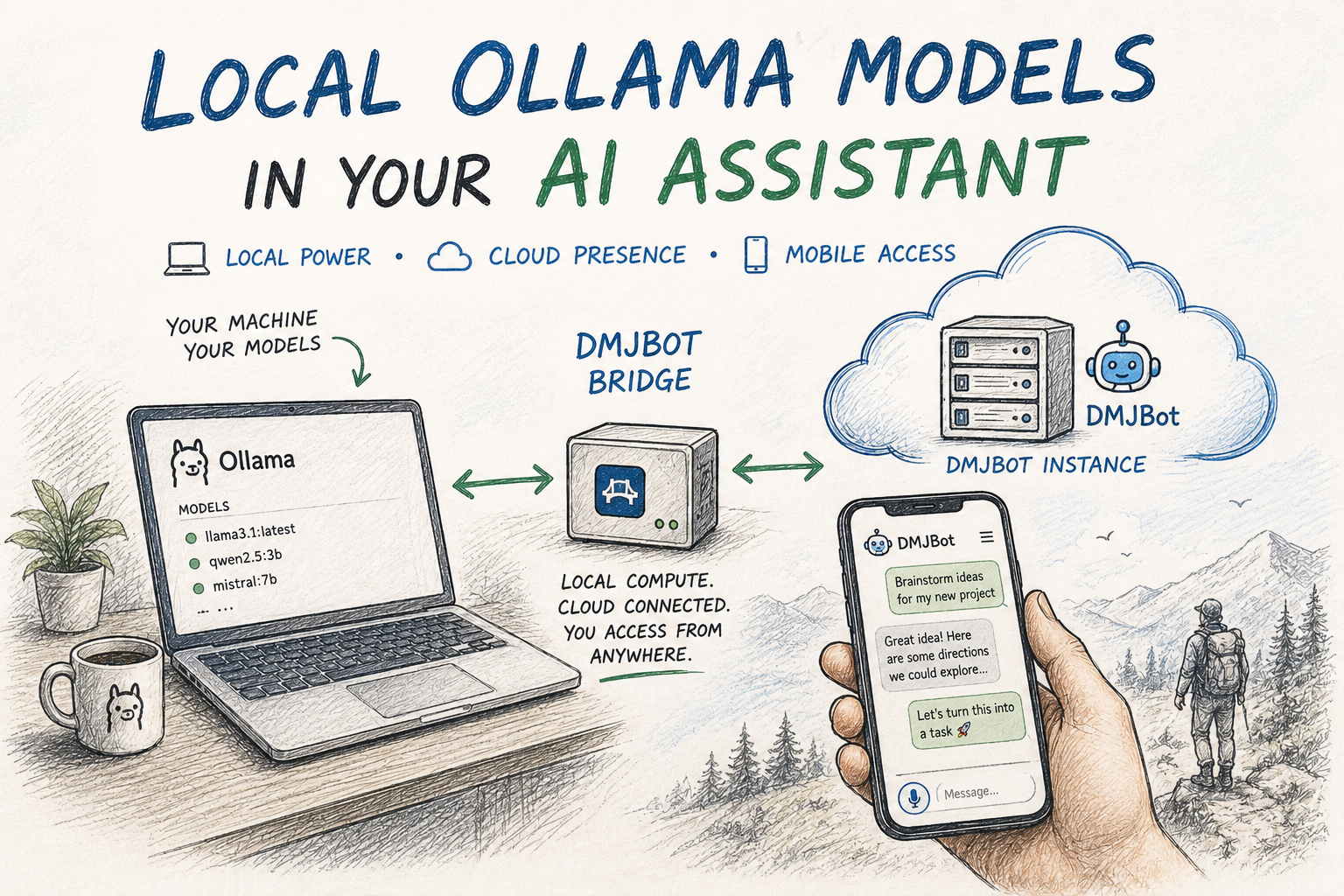
DMJBot takes the opposite approach. The only thing that runs is the brain, inside a Docker container. System requirements are minimal — it's just the orchestrator, not a desktop it has to occupy.

From there, you connect devices to it — one or many — and you decide how much each one shares:

  • full control of a device, if you want that, or
Continue Reading ...

A Real Day With DMJBot: It Shipped a Task While I Was Away

A Real Day With DMJBot: It Shipped a Task While I Was Away

Most demos of AI assistants look the same: you type, it answers, you type again. Useful, sure — but you are still the one doing the waiting, the watching, and the wiring.

This post is different. It is a real, end-to-end story of DMJBot doing an actual piece of my work — from "is this even ready yet?" all the way to "here is the finished report" — while I was away from my laptop. No babysitting. Five screenshots, one continuous flow.

Here is exactly what happened.

The setup

I had a Jira task, SCRUM-1, waiting on me: an experiment with group communication — adding emotional status emojis to messages. But I couldn't start it yet, because the final requirements were coming from a colleague, Roman Doubush, and he was going to send them over Slack "soon."

Classic blocked-work limbo. Normally that means I keep one eye on Slack all afternoon. Instead, I handed the whole thing to my assistant.

Step 1 — "Has the data arrived yet?"

First I just asked a simple question: did Doubush say anything about the task requirements in Slack recently?

The assistant didn't guess. It went and checked — read the channel messages, listed the users, scanned the recent DMs — and came back with a clear answer:

No — nothing about task requirements. The only recent DM from Doubush says: "Will you be at the call today?" So no signals about requirements being ready or anything SCRUM-related yet.

image

Continue Reading ...

Hello World — Meet DMJBot, Your AI Employee

Hello World — Meet DMJBot, Your AI Employee

Hello, world! This is the very first post on the DMJBot blog, so it feels right to start at the beginning: what we are building, and — more importantly — why we decided to build it.

DMJBot stands for "Do My Job Bot." It is a personal AI assistant for work automation. Not another chat window you have to babysit, but an AI employee that keeps working for you 24/7 — while you sleep, jog, play tennis, or simply get on with your life.

The conversation that started it all

The idea began with a simple question.

"Recently I asked my tech-experienced husband whether ChatGPT could now do his everyday work for him, by itself. The answer was no. ChatGPT and other popular tools only work when you are sitting in front of your computer, constantly asking them something. The same is true for AI coding assistants. All of these tools are passive — they wait until you ask. To get real automation you need an orchestrator, and that is complex to set up."

That answer was the spark.

Continue Reading ...